Why staying present while teaching is so hard, and what actually helps
The short answer: While you teach, your working memory is holding the sequence, the timing, the sides, your next sentence, and the room, which is more than it can comfortably carry. Cognitive science calls the fix offloading: move the sequence and timing onto something outside your head so your attention can stay on the students.
The juggling act nobody warned you about
Here is an incomplete list of what you are tracking at any moment while teaching: the pose the room is in, how long it has been there, which side you are on, the next pose, the transition into it, the sentence you are about to say, the student who mentioned her shoulder, the clock on the wall, and whether the music is about to change mood at exactly the wrong time.
Teacher training prepares you for the poses. It rarely names the real difficulty, which is that teaching is a sustained attention problem.
Working memory is smaller than the job
The part of your mind that holds information in the moment, working memory, is small. The classic modern estimate, from Nelson Cowan's much-cited review, is that the focus of attention holds about four chunks of information at a time, not the seven of older folklore.
A 60-minute class might hold 20 poses across five or six sections, most with a side, a duration, and a cue. That is far past any human's working span. Holding it in your head means constant silent rehearsal, and rehearsal competes directly with the thing that makes teaching good: attention on the people in front of you.
So when the middle of your sequence vanishes mid-class, that is not a discipline failure or a sign you are not ready. It is capacity. The system was full.
The fix has a name: cognitive offloading
Cognitive scientists call it offloading: using physical action or an external resource to reduce the information-processing demands of a task. Risko and Gilbert's review in Trends in Cognitive Sciences defines it exactly that way, and you already do it everywhere else. A shopping list is offloading. A calendar is offloading. Tilting your head to read a sideways label is offloading.
Offloading the class plan means the sequence, the sides, and the timing live somewhere you can glance at, so working memory does not have to carry them. What is left in your head is the part only you can do.
Even experts work this way
If using an external aid feels like something only new teachers should need, consider who else performs from one. Surgeons run the WHO Surgical Safety Checklist, and the research on it, including large multi-country studies, found fewer complications when it was used. Pilots fly with checklists on every single flight. These are among the most practiced professionals in the world, and the point of their scaffolds is precisely that expertise does not enlarge working memory. Under load, everyone benefits from not having to remember.
A teacher glancing at a clear plan is in that company, not in remedial class.
What to offload, and what to keep
Not everything belongs outside your head.
- Offload: the pose order, the sides, the durations, the section structure, and the cue wording you tend to lose under pressure.
- Keep: your voice, your judgment about the actual bodies in the room, the decision to slow down, and the theme you care about. No aid can do these, which is exactly why you want your attention free for them.
The practical versions of this are covered in how to remember your sequence while teaching: chunks, anchor poses, and a glanceable plan.
Reflection closes the loop
One more finding worth stealing from the research: brief, structured reflection after doing a task measurably improves later performance. In a series of studies by Di Stefano, Gino, Pisano, and Staats, a few minutes of written reflection after work improved subsequent performance by roughly 20 percent. For a teacher, that is two lines after class, what landed and what dragged, attached to the plan it came from. Over weeks, those notes become the difference between repeating a year of teaching and accumulating one.
How this shaped Cue
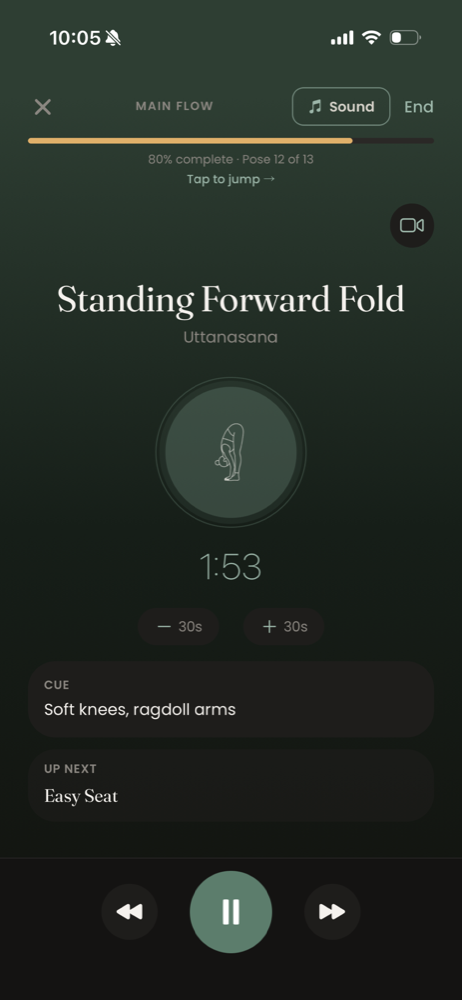
I built Cue around this literature, and I try to be careful about the claim: Cue applies these findings, it does not prove them. The teaching view holds the sequence, the timing, the sides, and your own cue in one glanceable screen, so working memory does not have to. The reflection prompt appears right after you finish, while you still remember. The design bet is simple: the less of your class you have to carry in your head, the more of you is available to the room.
Frequently asked questions
Is teaching yoga with notes unprofessional? No. Surgeons and pilots, among the most practiced professionals anywhere, perform with checklists in view. Students respond to whether you are present with them, and a glanceable plan is one of the most reliable ways to make that possible.
Does the mental load go away with experience? It shrinks but does not disappear. Experience automates familiar phrases and transitions, which frees capacity, but a new sequence, a bigger room, or a hard day fills working memory right back up. Experienced teachers tend to manage load with structure and repetition rather than raw memory.
If I offload my sequence, will I stop learning it? Sequences become memorized through teaching them, not through straining to recall them. An external plan removes the panic, and repetition does the memorizing. Most teachers find they glance less each time they teach the same class.
Can you really not multitask while teaching? Attention shifts quickly between things rather than truly splitting. Every extra thing held in mind, like a memorized sequence, adds switching cost. Reducing what must be held is the most practical way to seem, and be, more present.
Sources
- Risko & Gilbert (2016), "Cognitive Offloading," Trends in Cognitive Sciences
- Cowan (2001), "The magical number 4 in short-term memory," Behavioral and Brain Sciences
- Systematic review of surgical safety checklist outcomes (2024)
- Di Stefano, Gino, Pisano & Staats, "Learning by Thinking: How Reflection Improves Performance"
Cue applies these findings to teaching tools. Nothing here is a clinical claim about brain function.
Plan it once. Teach it present.
Cue keeps your sequence, your own cues, the breath and the timing on one screen you can read from across the room. Free to start, and it runs in a browser.
Let Cue hold the sequence