How to plan a yoga class, step by step
The short answer: Decide what your class is about in one sentence. Choose a peak, then work backwards to prepare the body for it. Divide the class into timed sections, write the cues you will actually say, and make one note after class about what worked.
That is the method. The order is what makes it fast.
Why planning a yoga class can take forever
My old method was paper. Sit down on Sunday night, write the class out longhand, scribble half of it out, squeeze the fix into the margin, and then realize I could not read my own notes anymore and copy the whole thing out again. Some classes I wrote four times before I ever taught them once.
The problem was not that I needed more poses. I was trying to make every decision at once: what the class was about, where it was going, which poses belonged, how long everything should take, and what I wanted to say.
A blank page asks all of those questions at the same time. Planning gets faster when each decision narrows the next one.
1. Start with the shape, or the theme, in one sentence
Before choosing a pose, write one sentence about what the class is. It can be physical, energetic, or a theme you care about:
- This is a heart-opening class that ends in a long, quiet fold.
- This class builds heat in the legs and ends with the spine long.
- This is a slow, grounding class for a stressed Monday evening.
That sentence gives every later decision a filter. If the class ends quiet, you probably are not putting your deepest backbend five minutes before savasana. You just removed a lot of possible poses without having to debate each one.
The sentence does not have to be strict, and shape and theme can be the same thing. A heart-opening class is both a direction for the body and an idea you can share. What matters is that the class has one, because a class with no direction feels like a playlist on shuffle, and students feel it even when they cannot name it.
2. Pick the peak, then sequence backwards
Decide where the class is going before you decide how it starts.
If the peak is Bird of Paradise, ask what needs to be available by the time students arrive there:
- hamstring length
- shoulder mobility for the bind
- balance on one leg
Now the middle of the class has three clear threads. You can introduce each one, repeat it, and gradually bring them together.
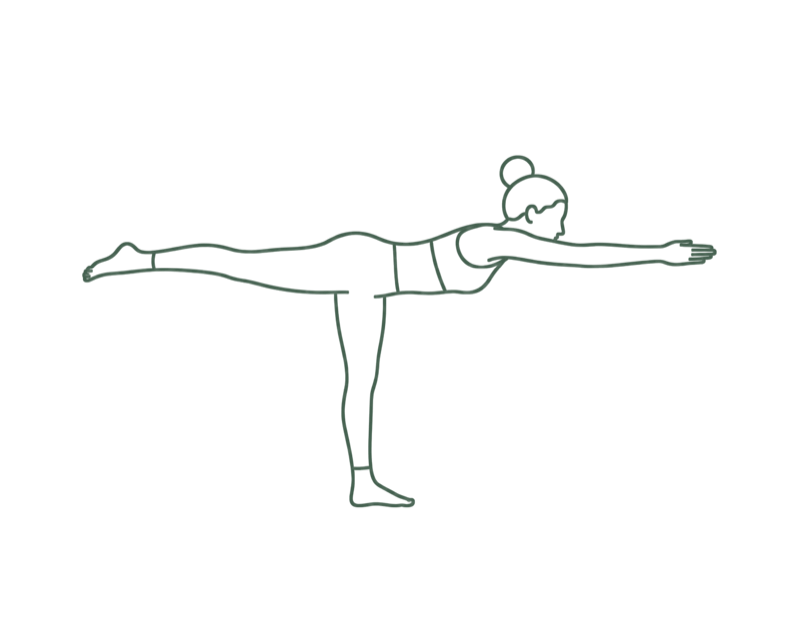
Your peak does not need to be dramatic. In a restorative class, it might be a five-minute supported fish. In a beginner class, it might be a steady Warrior III with a wall nearby. The peak is simply the moment the class has prepared for.
A useful rule: everything before the peak earns it; everything after the peak helps the body settle.
3. Plan sections before individual poses
Most 60-minute classes can fit into six sections:
| Section | Example time |
|---|---|
| Arrive | 5 minutes |
| Warm | 10 minutes |
| Build | 20 minutes |
| Peak | 8 minutes |
| Unwind | 10 minutes |
| Rest | 7 minutes |
Set the rough timing while the sections are still empty. This stops the build from quietly eating the end of class and turning savasana into whatever time is left.
Then fill each section with short phrases, not one endless chain. Three poses repeated twice are easier to learn and teach than six unrelated poses in a row. Repetition also gives students a second chance to understand the movement.
These six sections are also how the builder in Cue is laid out, so if you plan there, the structure is waiting for you.
4. Write the cue, not only the pose name
This is where a sequence becomes something you can actually teach.
"Warrior II" is a label. "Drop the back heel, then turn your ribs" is something you can say.
Write one or two useful cues for the poses where you tend to lose your words. Use your own shorthand. My plans include notes like "arms first, then breath" and "make this one hard." They would mean very little to another teacher and exactly what I need at 7 p.m. on a Tuesday.
The test is not whether your plan looks complete. It is whether you can teach from it when you are tired and slightly nervous.
This is also where Cue becomes useful: you can keep the sequence, timing, and your own teaching words together instead of planning in one place and teaching from another.
5. Make one note right after class
Before the details blur, write two lines:
- What landed?
- What dragged?
Maybe the second side of the lunge series felt too long. Maybe nobody understood the bind cue. Maybe the transition into pigeon was seamless and should stay forever.
A sequence you wrote is a hypothesis. A sequence you taught and reflected on is evidence. Keep making tiny notes and, within a few weeks, you will be planning from your own body of work instead of a blank page.
Cue lets you save that reflection with the class while it is still fresh. The next time you duplicate or adapt the sequence, the lesson comes with it.
Reuse the classes that work
Experienced teachers are not inventing a completely new class every week. They are adapting.
Name your plans so you can find them later. "Power · legs + shoulders · Warrior III" is much more useful than "Class 14." Keep the classes that worked, change one or two elements, and teach them again. A class you have taught three times is usually better than a class you have written once.
You can do all of this on paper. I built Cue because I wanted the plan to stay useful after I left my desk: build the sequence, keep my cues and timing with it, teach from a clear screen, then save what I learned afterwards.
Start with the sentence. Build backwards. Write what you will say. Keep what worked.
Frequently asked questions
How long should it take to plan a yoga class? Once you have a repeatable method, allow about 20 to 30 minutes to build a new 60-minute class and roughly 10 minutes to adapt one you have already taught. If planning routinely takes two hours, decide on the class shape and peak before choosing individual poses.
Should I write the whole yoga sequence or only the key poses? Write the full order, but add detailed cues only where you need them. Teachers often over-write the familiar warm-up and under-write the peak, which is exactly where the plan is most useful.
Does every yoga class need a theme? No. A clear physical or energetic direction matters more than a forced theme. If an idea feels honest and useful, include it. If you are inventing one on the drive over, let the movement speak for itself.
How do I plan for beginners? Use fewer poses, allow more time to enter each one, and plan a modification you have actually practiced. Keep the class direction, but make the peak a reachable milestone rather than the most advanced possible shape.
Plan it once. Teach it present.
Cue keeps your sequence, your own cues, the breath and the timing on one screen you can read from across the room. Free to start, and it runs in a browser.
Build your next class in Cue