How to remember your yoga sequence while teaching
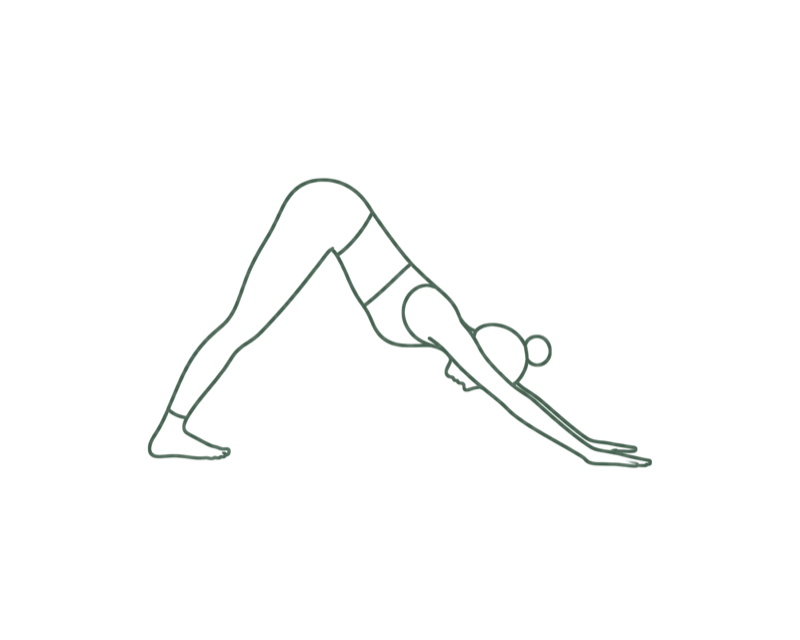
The short answer: Build your class in repeating chunks of three or four poses, give each chunk an anchor pose, rehearse the transitions in your body once, and keep a plan in the room that you can read at a glance. The goal is not to remember harder. It is to hold less in your head.
Why your sequence disappears when class starts
You knew the whole thing in the car. Then twelve people sat down, someone asked about their knee, the music was too loud, and the middle of the sequence vanished.
While teaching, you are tracking the next pose, the side, the clock, your words, the student by the window, and whatever you planned to change on round two. Your sequence is competing with all of it.
That is why "practice it more" only half solves the problem. Rehearsal helps, but strong systems help more. Calm teachers are not always remembering more. They have arranged the class so less memory is required. (There is real cognitive science behind this; here is the longer version.)
1. Turn the sequence into small chunks
A list of 28 poses is hard to remember. Seven short phrases are manageable.
Group the class into pieces that make sense together: a lunge phrase, a balance phrase, a floor phrase. The poses inside each chunk should follow naturally enough that remembering the first one helps you find the rest. This is the same logic as planning in sections, carried into the room.
If every pose has to be remembered separately, the chunk is not helping, and the sequence may feel just as disconnected to students.
2. Repeat before you add
The fastest way to cut the memory load is to repeat a phrase.
Teach it on the right and the left. Teach it slowly, then connect it with breath. Repeat it and add one pose the second time.
Repetition is not filler. It gives students time to learn the movement, and it gives you a structure you can trust. Most of my classes that feel especially clean include a phrase that returns.
3. Choose an anchor pose for every chunk
An anchor is a pose you return to and are unlikely to forget: Downward Dog, Tadasana, Tabletop, or a seated pause.
It tells you where one phrase ends and the next begins. It also buys you a breath if your mind goes blank. One extra breath in Downward Dog does not look like a mistake. It looks like one extra breath in Downward Dog.
4. Rehearse the transitions in your body
Reading a plan five times creates familiarity. Moving through it once teaches you where it actually gets awkward.
You do not need to practice the entire class. Stand up and walk through the transitions. Turn in the real direction. Step the real foot back. Notice if the sequence strands you facing the wrong way or puts all the work on one wrist.
Transitions are where a plan usually breaks, because a pose is something you know and a transition is something you have to do.
5. Say the first cue out loud
For each chunk, practice its opening sentence, not only the pose name.
Speaking is different from thinking. The first line often unlocks everything that follows. Teachers rarely get stuck halfway through a familiar phrase. We get stuck at the entrance, with a movement in mind and no words attached to it.
6. Make your notes glanceable
If you are going to use a plan during class, and you should be allowed to, it needs to survive a one-second glance from a few feet away.
Use:
- one movement per line
- clear right and left markers
- one useful cue instead of a paragraph
- a visible time or breath count where it matters
Then test it. Put the plan where you will teach, stand at the other end of the mat, and see if you can read it without crouching.
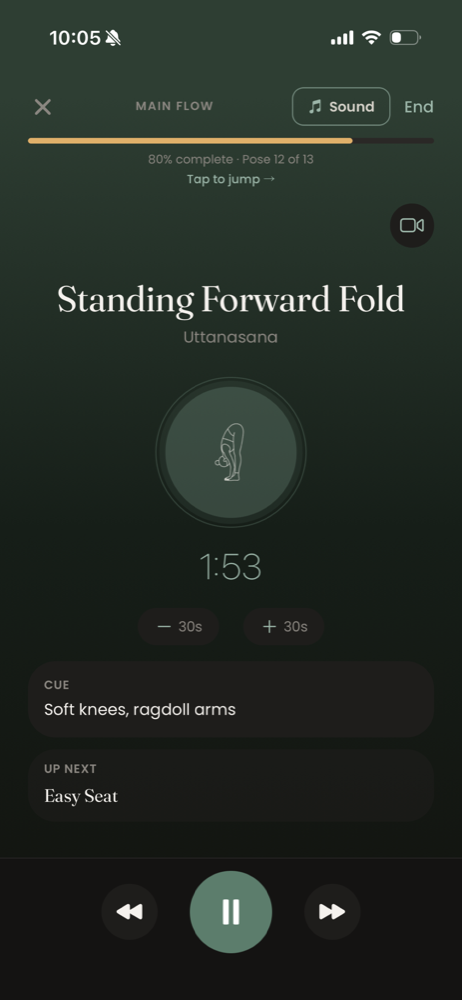
That teaching moment is exactly why I built Cue. A plan that looks lovely at a desk can be useless from the front of a room. Cue turns the class you built into a teaching view with the current pose, your cue, and timing large enough to check without leaving the class:
7. Put the plan where you can see it
A notebook flat on the floor is hard to use. You have to break your posture, find the right line, and hope the page stays open.
Place your phone or tablet near eye level at the front of your mat. If you use a phone, make sure the screen will not lock halfway through. The easier the plan is to glance at, the more present you can be when you look back up.
8. Plan what you will do when you blank
You will lose your place eventually. Every teacher does. Choose a recovery before class:
- Return to the anchor pose.
- Repeat the phrase you just taught.
- Take three breaths where you are.
Students usually experience all three as normal teaching choices. The uncomfortable part is not the pause; it is the panic after the pause. A rehearsed recovery stops the spiral.
Try this before your next class
Take the sequence you already plan to teach and spend 15 minutes on three things:
- Divide it into chunks of three or four poses.
- Mark one anchor for each chunk.
- Rewrite the hardest lines using the words you actually want to say.
Then practice only the transitions.
If you want the plan in the room without teaching from a page of tiny notes, add that same sequence to Cue and open its teaching view. You do not need to abandon your method or memorize the class again. You just need the right information where you can see it.
Frequently asked questions
Is it bad to teach yoga with notes? No. Students care whether you are present and responsive. A quick glance at a clear plan is often less distracting than trying to retrieve pose eleven while staring into the middle distance.
How do I memorize a long set sequence such as Ashtanga? Set series are learned through repeated practice over time. They are different from a class you write yourself. For your own sequences, chunks and anchors are faster and easier to adapt.
How do I stop forgetting which side I am on? Mark sides explicitly and make the second side a mirror of the first whenever possible. Saying "right foot forward" out loud at the start helps both you and the room.
Should I write a full yoga class script? Usually not. A paragraph is difficult to re-enter after looking away. Use one or two cues per pose, and fully script only the parts you want to say precisely, such as an opening, closing, or short teaching point.
Plan it once. Teach it present.
Cue keeps your sequence, your own cues, the breath and the timing on one screen you can read from across the room. Free to start, and it runs in a browser.
Teach your sequence from Cue