Should you use AI to help plan your yoga classes?
The short answer: AI is genuinely useful for the blank-page moment: it can draft a structured class in seconds, and it is good at adapting, shortening, or reworking a sequence. It cannot know your students, your room, or your voice. Treat every AI sequence as a first draft, rewrite the cues in your own words, and keep the teaching decisions yours.
The honest answer is: for the first draft, yes
Every teacher knows the blank-page moment. You know roughly what Tuesday's class should be, and yet the page stays empty while you scroll someone else's flow and feel vaguely guilty about it.
That moment is exactly what AI is good at. Give it the style, the length, the level, and a focus, and it will hand you a complete, structured draft in seconds. Not a perfect class. A draft, which is a very different thing from an empty page, because editing is faster and more honest work than starting.
What AI does well
- Structure on demand. A competent arc, warm-up through rest, in seconds, which beats assembling one from scratch when you are tired.
- Adaptation. Shorten a 60-minute class to 45, swap out the poses that need a wall, make the same class gentler. Mechanical changes AI handles well.
- Getting you out of a rut. If you have taught the same three openings all month, a draft you did not write will suggest a door you would not have opened.
What AI cannot do
- See the room. It does not know that Tuesday's group skews stiff and tired, that one student is pregnant, or that the person by the window is guarding a shoulder. Reading bodies is the professional skill, and it stays yours.
- Sound like you. AI cues are serviceable and generic. "Ground through the outer edge of the back foot" is fine; the words that make your students feel taught are the ones only you say.
- Take responsibility. You are the teacher. Every pose you offer a real body is your call, whatever drafted it.
Is it cheating?
Using AI to draft a sequence is like a musician using a songbook. Nobody in the room experiences your planning process. They experience your presence, your cues, your pacing, and your attention. If a faster draft buys you an extra half hour of rest, or ten more minutes refining the cues that matter, the class got better, not less honest.
Where it would go wrong is teaching an AI sequence unread. Not because of where it came from, but because teaching any sequence you have not made yours is how classes go sideways.
Four rules for using it well
- Treat every AI class as a first draft. Read the whole thing before you trust it.
- Rewrite the cues in your own words. This is the single highest-value edit, and it is also how the class becomes yours.
- Walk the transitions in your body once. AI does not have knees. If a transition feels wrong, it is wrong.
- Keep your peak logic. Decide what the class is building toward, and make the draft serve it, not the other way around.
Where Cue fits
Most AI tools hand you a wall of text you then have to retype somewhere useful. Cue's AI drafts straight into the visual builder: every pose is a card you can reorder, retime, swap, or delete, and every pose has a field for your own cue right there. The draft arrives already editable, and the editing is the point.
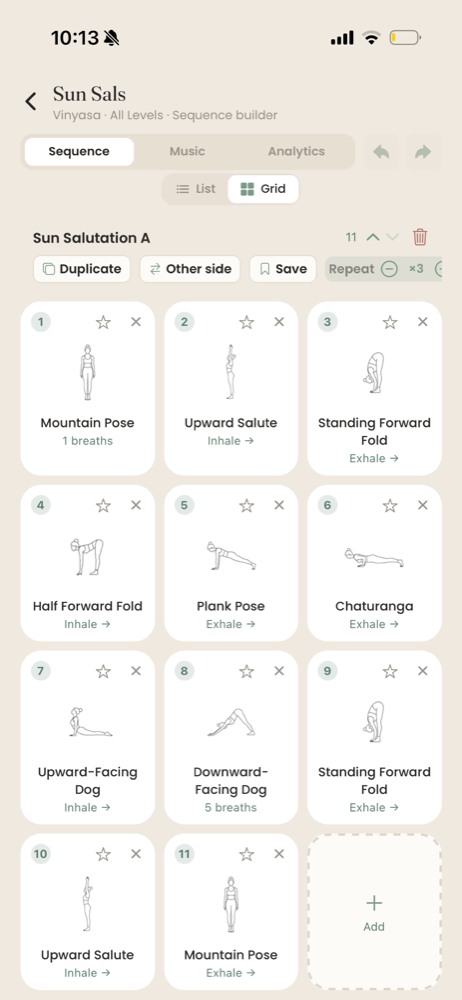
Then the class goes with you: the same sequence becomes the teaching screen, with your cues and timing in view while you teach. Draft fast, edit honestly, teach present.
Frequently asked questions
Will my students be able to tell the class was AI-drafted? Not if you edited it. Students experience your delivery, your cues, and your attention, none of which AI provides. If a class feels generic, the fix is the same as it always was: rewrite the cues in your voice and shape the class for the people who actually come.
Is AI yoga sequencing safe? As safe as the teacher reviewing it. AI can produce reasonable structure and occasionally an unwise transition, which is why the draft-then-edit rule matters. You bring the knowledge of contraindications and of the bodies in front of you.
Can AI replace yoga teachers? It can generate sequences, and there are apps that guide solo practice. Teaching a room, reading bodies, adjusting in real time, and holding attention is a different job, and it is the part students actually pay for.
What is the best way to use AI for class planning? Use a tool that outputs an editable sequence rather than a wall of chat text, give it specific constraints (length, level, focus, what to avoid), and budget your saved time for editing cues and transitions. The draft is the start of planning, not the end.
Plan it once. Teach it present.
Cue keeps your sequence, your own cues, the breath and the timing on one screen you can read from across the room. Free to start, and it runs in a browser.
Try Cue's AI on a blank page